
How Much Does It Cost to Launch an eSIM App in 2025?

The fast-emerging technology for mobile connectivity today is eSIM because it serves as the new industry standard. The eSIM technology enables mobile network switching directly inside smartphones and other devices alongside tablets and smartwatches without the need for traditional SIM card replacement. eSIM technology delivers better convenience to consumers while enabling businesses to handle interruptions in their network connections more easily.
The global embedded SIM (eSIM) market market size was $4.7 billion in 2023. Intense development has been predicted in future years; as per the market size, the market has up to $16.3 billion by 2027.
To the stakeholders in business organizations and other individuals, eSIM apps are very vital in the dynamics of mobile data plans, and global subscription services. As more firms understand the potential of eSIM technology, the need for apps that can support these services is rapidly increasing.
So, in this article, you will discover main factors which affect the cost of eSIM application development. Here, we are going to discuss some important aspects of eSIM apps, including essential features, development phases, regional cost differences, and potential revenue models for your project.
What is an eSIM App?

An eSIM (embedded SIM) is a digital SIM that is integrated in a user’s device and allows the client to connect to a particular mobile network without needing a physical SIM card. Compared with the physical card, which is easily removable and requires physical insertion of a new card when switching to a new service provider, eSIM is built as part of the device hardware. This enables a user to change from one network or to turn on other data services with lots of ease, thereby enhancing flexibility of connectivity.
There is an eSIM application which is responsible for controlling these features. By using the app, one is able to choose its carriers, control data tariffs, activate or deactivate services and observe its usage without the need of the SIMs. In a way, tourists or those who administer a number of networks will appreciate the convenience that eSIM applications allow – simply transferring between different giants across the globe without the added hassle.
The need for an international connection has boosted the possibility of eSIM applications to the greatest extent. Since more and more electronic devices are equipped with eSIM, the market for these applications is rapidly growing. This trend is coming from both consumers and businesses who are demanding solutions that aren’t as restrictive as SIM cards, and change how they use their mobile devices across networks and internationally. The benefits of investing in eSIM apps can introduce many potential customers for business, particularly for the travel, telecom and IoT sectors.
Key Features of an eSIM App

Here, the use of eight essential features that would lead to the creation of the perfect eSIM application is outlined. These features help the users be able to secure the management of their mobile network services hence making the app crucial for the efficiency of network services. Let’s dive into the key features every eSIM app should include:
User Authentication and Verification
Another important consideration when designing eSIM applications is dealing with the user ID and other personal data security. As the app primarily deals with certain critical data such as mobile numbers, carrier details and billing information, strict identity controls are needed.
Other ways that users can be authenticated include use of two-factor authentication (2FA), Biometrics (using fingerprint, face, etc.), and Password hashing. Of equal significance, these methods assist in ensuring that only people with an authorization code are able to gain access to the application, as well as protecting the personal data held in the application. Also, choosing security as the primary need will allow to gain the confidence of users, which is the crucial factor for the app to continue its activity later.
Multiple Network Support
To the users that need to be connected in many regions or countries, multiple network support as a valuable feature is mandatory. It should be able to link with many different MNOs and users should be able to transfer to different carriers depending on the place, price or quality of service.
The greater choices of networks an app can deliver, the more utility it has as an app. This means that regardless of whether the user travels often or only wishes to compare local rates, she or he can remain connected at all times. eSIM apps drive multiple networks that assist the users in making real time choices that are convenient for them rather than stay locked up in a portable SIM card.
Data Plans and Subscription Management
But without a doubt, one of the biggest perks of an eSIM app is when it is possible to buy and control data packages from within the app. In place of going to the store or online store of a mobile carrier, users can search the available plans, get its subscription or control the existing one directly on the device.
The app should have a variety of plan types, local, regional, and global plans, and the price as well as duration should be easily understandable. Thus, gaining access to multiple plans within the very app, in addition to being more convenient, also helps to avoid extremely high tariffs for roaming when you are abroad. The features that relate to the subscription include automatic renewal of subscription, notifications in terms of data usage and an easy option to cancel the subscription makes the connectivity effective and fast.
Carrier and Device Integration
An underlying feature of eSIM apps is that communication between the telecom providers and the device is fully integrated. The app has to work with various telecom carriers’ systems to perform activation, provisioning and further management of eSIM profiles among others. This is usually done via APIs from carriers; the app can then enable or disable eSIM, get to know available plans and alter the preferences.
Furthermore, there are certain devices which it must support and properly integrate with, or it will be of no use. Before committing to eSIM technology, smartphones, tablets and wearables should be in a position to detect the eSIM, download the profile as well as transition between the different networks seamlessly. Compatibility with multiple programs, devices and carrier will improve the app’s functionality and popularity among consumers and businesses, making the tool efficient.
NEED APP DEVELOPMENT EXPERTISE?

Full Development Cycle of an eSIM App

The creation of the eSIM app will be in the following stages: They are as follows; The main steps involved in the creation of the eSIM app include: The described phase equally contributes to the development of a smooth product allowing for constant connection, security, and enhancing users’ experience. Here’s a breakdown of the full development cycle of an eSIM app:
1. Research and Planning
Thus effective and prior research and planning is crucial to any type of development. This phase lays down a roadmap for the rest of the project and must be taken seriously. This involves research aimed at identifying the demand of customers, the competition and the gap within the market. Out of existing eSIM apps, since they are already in the market with many consumers, businesses are able to learn which features the consumers prefer most and where they can innovate.
Once the market is analyzed, that’s when the competitors come into play. This step entails analysis of what competitors are offering and how your app will possibly be unique in the market. Stating these goals at this early stages help to guide design and development of the app, so all decisions are consistent with the vision. What challenges do the app address? Who is the target audience? What growth model for the business? Answering these questions will bring out a development plan that acts as a map throughout the development process.
2. UI/UX Design
Arguably, once the goals are defined, it is essential to move on to shaping the user interface (UI) and the user experience (UX). It is more about the appearance and user interface of the app all rounded up to create a great impression on the users. The idea is to design an understandable interface of the app where a user is able to switch between functions like choosing a carrier, coming up with a list of data plans, making subscriptions subscribe to, etc.
The UI/UX plays a crucial part in the efficiency and usability of websites and softwares. If the users are losing their way while in the application, or if they are unable to locate the features they need or want, these users will not invest their time using the app. When users see that the application is well thought-out and uncluttered, they will get how to use it and locate the features they desire with ease within a short space of time. This is in the form of well-articulated instructions, clearly presented messages, good graphic designs and sequences; and, that all engagements are accessible on portable gadgets.
Also, creating a logical progression from creating an account to assigning data plans makes sure the users remain engaged, as they’ll not easily abandon the application.
3. Backend and API Development
Backend development stage is the stage where most of the key features of the application are implemented. This involves the creation and design of the server logic side and the database in which all user and application information will be kept. Backend associated with a different set of priorities such as the user identity, data storage and data transmission with telecom companies.
API integration with the telecom providers is one of the key points of backend development for an eSIM app. These APIs enable the app to power on/party on, as well as power off /deactivate eSIMS, and interact with many networks. Appropriate incorporation makes it easy for the users to move from one carrier to another, buy data plans as well as receive real-time information on their network.
Security is of high priority at this stage because the app will now contain a user’s personal information. Appropriate security measures have to be introduced, such as data protection and ciphers and access credentials to preserve the confidentiality of a user.
4. Frontend Development
While a backend developer deals with what happens at the back end, the frontend developer focuses on the area visible to users. This is directly linked to users and as such must be made to be as fluid and quick to respond as is possible.
Frontend developers ensure that the designed UI/UX are implemented into an app and brought to the physical world. The suggested app must require minimum time to load, adapt to any screen size and also should have an appropriate and appealing interface with active reaction to the input. Also important when it comes to an eSIM app is the compatibility across devices given that shall be usable on iOS and Android.
Project creators have an array of options, starting from native development, which aims at building distinctive apps for the two platforms, iOS and Android, to using cross-platform frameworks like Flutter or React Native, designed for creating an app once for both platforms. Depending on the budget of your current project, the time you can allocate, and our growth objectives the decision here will be made.
5. Testing and Quality Assurance
As with all software applications there is no application that can be developed and released to the public without going through rigorous testing and quality assurance (QA). The rationale for testing is to confirm that the app runs smoothly, has no glitches, and is safe for the users. Some of the aspects that QA teams look for include functionality, speed, cross-browser and device compatibility, and security.
An eSIM Core App needs to be designed with specific attention to Network Switching, API responses and Data Management. It is critical to perform stress testing to prove that the app will work in conjunction with many carrier affiliations without freezing or slowing down. Moreover, the security testing is important to make sure that users’ data are protected from the potential hacking since the application will store personal identification and some other financial operations.
6. Deployment and Launch
After that, the last stage is deployment and launching of the app if it has passed the QA department. This involves submitting the app to the App Store (iOS) and Google Play (Android) while ensuring the have met all the necessary criterion that is required by the two stores. This process also involves creating marketing assets such as descriptions of the app, screenshots, and videos that can be useful in persuading the targeted users to make use of the app.
While launching it is essential that someone devises a plan as to how the word will go round, to the right audience. The strategies on which it might be worthwhile to focus include offering promotions, mastering app store optimization, or collecting user feedback to fine-tune the app after the launch.
TAKE THE FIRST STEP TOWARD SUCCESS!

Platform Considerations: iOS, Android, or Both?
When choosing the platform for the building of an eSIM app, the benefits and disadvantages of targeting either iOS or Android, or both, must be considered. Different platforms can mean different propositions that reflect on development costs and determine the user satisfaction level.
Native Development
Developing native applications means basically designing and programming two different applications, each for iOS and Android with consideration to the guidelines of these platforms. This approach offers several advantages:
- Optimized Performance: Native apps tend to be more effective because they make use of platform specific characteristics as well as application programming interfaces. This leads to a better user experience, quicker time to first Byte, and better performance.
- Enhanced User Experience: Developers can build the application with direct compliance to the design of every platform which makes it easier and familiar to the user.
- Access to Native Features: Native development works well with eSIM app functionalities since: Native development allows full access to the device as(push notifications, cameras, and other security options, etc.).
However, the major weakness of native development is the aspect of cost. The decision to develop two different apps results in the elimination of this outcome and increasing the overall spending on app development by twice. Furthermore, the management and also the update of two code bases may also cause additional complications to future enhancements and thus additional operating cost.
Cross-Platform Development (Flutter)
On the other hand, cross-platform tools such as Flutter allow a developer to create an application that will run on both devices. This approach offers several significant benefits:
- Cost Savings: The creation of one codebase is considerably more cost-effective because email providers can consolidate their resources. Such data does not have to be repeated and updated concurrently on different platforms as it would with a website.
- Faster Time to Market: The numbers indicate that using a single codebase as a starting point for development is advantageous for eSIM applications; it can be faster than other development approaches, enabling businesses to create new apps and rapidly gain a competitive edge.
- Consistent User Experience: The advantage of cross-platform development is the ability to create a single design, which provides a coherent image of the product and thought through branding.
However, there are some limitations to be taken into account when instituting it. Thus, the Flutter has been continuously improving to allow for accessing the native features; however, there still might be some necessary advanced elements that would need the extra additional workarounds as well as custom native modules to deal with. Moreover, they lack some functionalities akin to native performance, especially when it comes to tasks that require many resources.
Special Programming Considerations
Assuming the implementation of eSIM technology, there are certain technical issues inherent to the development of this technology whatever method is chosen. Several of these considerations entail integration with telecom providers․ As eSIM apps interface with the user, they also have to interface with numerous carriers’ APIs to set up profiles, subscribe users, or cancel their subscriptions, and switch from one network to another.
To reap value from these telecom integrations, one must understand several protocols and standards that apply to these innovative setups like the GSMA standards for the eSIM. It also needs the developers to consider the legal requirements of the country of its location particularly when dealing with personal user data.
The factors that influence the decision between native and cross- platform development depend on the choice between a native eSIM app and a cross- platform one are, the budget, amount of time available and the target users’ experience as well as the complexities of the integration with telecom companies. Analyzing these factors allows making the best decision for target clients and business goals, contributing to its success.
Tech Stack for eSIM App Development
Selecting the correct tech stack is critical to successful development of an eSIM app. The tech stack also has implications on scalability, maintainability, and further evolution of the app as well as the more direct concerns of speed and interaction, covered by performance. Depending on one’s choice of going with native mobile applications or developing a cross-platform application, the options for technologies are different.
Native Development Tech Stack
2. iOS Development:
- Swift: Being the main language for iOS development, Swift is preferred due to its speed, security, and the syntax used. It seamlessly supports integrating with most of Apples APIs & frameworks that make it perfect for creating high-performance apps.
- Xcode: This is the only IDE for iOS development that is officially recognized. Xcode tools are meant for building and testing applications as well as for application debugging.
2. Android Development:
- Kotlin: It is a simple language with shorter codes and highly interoperable with java being the preferred language for Android development. It improves efficiency, and minimizes redundancy.
- Android Studio: This is the recommended IDE for developing applications with the Android OS, featuring a veritable toolkit for design and code, as well as testing the completed projects.
Cross-Platform Development Tech Stack
1. Flutter:
- Dart: Dart which is used in flutter is also designed to program in such a way that it produces fast applications. The particular one is present with a capability allowing hot reload, and it instantly displays the changes that have been made to it to the respective developer, which makes the process much easier.
- Flutter Framework: Recommended for its superb UI features, Flutter will allow the development of beautiful applications on both the iOS and Android platforms from a single codebase.
2. React Native:
- JavaScript/TypeScript: React native empowers the use of JavaScript or its newer version TypeScript that many developers are familiar with hence improving development time.
- React Native Libraries: This framework provides an opportunity to use native components, while the performance is almost the same as in native applications, but at the same time, significant amounts of code can be reused across platforms.
Integration with Mobile Carriers
To ensure seamless functionality and compliance with eSIM standards, developers need to integrate various APIs and libraries:
- Carrier APIs: eSIM app requires these to facilitate its interaction with the MNOs in the provision of the eSIM solution. They take care of the more refined job of user profiles, planning of activation activities, and arrangements for deactivation also.
- GSMA Specifications: There is a set of rules to follow established by GSMA context, and it is important to mention it for eSIM. Libraries that support protocols defined by the GSMA group can also help reduce the difficult part of tying into carriers.
- Payment Gateways: There is a need for the provision of secure means for the purchase of the data plans. Some of the options include the stripe or the PayPal API.
Importance of Choosing the Right Tech Stack
Selecting the appropriate tech stack for eSIM app development is vital for several reasons:
- Scalability: A correct selection of a tech stack eventually lets increasing traffic loads and new features without major rewriting.
- Maintenance: If the technologies in question are popular and have communities working on projects associated with them, it is easier to maintain the app and fix issues that occurred so it stays functional and has all the most recent capabilities.
- Performance: Choosing the right stack can really make a huge difference in the performance of the app – factors such as load times or interactivity are paramount, particularly when dealing with connectivity heavy products like eSIM.
To sum it up, native or cross-platform, it is the choice of the right tech stack that defines the further development of an eSIM app that would provide users with all the value, continue to evolve, and successfully adapt in the ever-changing mobile environment.
UNLOCK YOUR PROJECT'S POTENTIAL WITH OUR COST CALCULATOR!

Regional Development Costs
One thing that needs to be considered when it comes to developing an eSIM app is the costs associated with the regions we are going to target. Some areas of the world can provide higher skills, price & bring products to market more cheaply and quickly than others. Here’s a breakdown of development cost estimates across several key regions:
1. Latin America
- General Cost Estimates: Development costs in Latin America typically range from $25 to $75 per hour.
Advantages: - Lower Labor Costs: Some of Brazil, Argentina, and Colombia are cheaper because the cost of living in these countries is less than in North America and most of Western Europe.
- Time Zone Compatibility: Basically, many of the Latin American affiliated countries share affinity with US time zones hence time difference is not a big issue while making communications.
- Growing Tech Ecosystem: More cities such as São Paulo and Buenos Aires are growing technology centers, thus generating better developers across the region.
2. Central & Eastern Europe
- Cost Estimates: Development costs in Central and Eastern Europe (CEE) generally range from $30 to $80 per hour.
Balance of Quality and Price: - Skilled Workforce: There is still a great interest from countries such as Poland, Ukraine and Hungary for high quality software development. Most developers are able to speak English well, hence cannot be a language barrier.
- Innovation and Agility: Some common characteristics of CEE firms involve use of the agile model, making schedules flexible and realistic in delivery.
- Competitive Pricing: The services that the current company provides are of high quality, but the costs remain low compared to countries in the western Europe and North America.
3. South Asia
- Cost Estimates: South Asia, particularly India, Pakistan, and Bangladesh, showcases some of the most competitive rates, ranging from $15 to $50 per hour.
Popular Outsourcing Destination:
- Cost Efficiency: South Asia has abundant human capital that comprises skilled IT professionals thus reducing development costs for businesses that outsource.
- Diverse Skill Set: The existing firms of South Asia have good knowledge and experience respectively in different technologies and sectors, which offer broad service portfolios and services at reasonable rates.
- Robust IT Infrastructure: The fact that many IT parks and technology centers exist mainly in India also adds to the outsourcing success.
4. Southeast Asia
- Cost Estimates: Development costs in Southeast Asia range from $20 to $60 per hour.
Growing Market:
- Emerging Talent Pool: Vietnam, Thailand and Indonesia are among the countries which are gradually building their high-qualified developers of the technology.
- Cost Variability: Pricing depends on the country of service, or a specialist, or the individual project complexity. For example, Vietnam is increasingly becoming popular because of its relatively low costs and a burgeoning population of tech talents.
- Government Support: Governments in Southeast Asia still encourage the formation of technology and innovation, hence there are friendly policies that have adopted tech startups and development firms.
5. North America
- Cost Estimates: In North America, development costs typically range from $100 to $250 per hour.
Higher Costs but Greater Expertise:
- Expertise and Experience: In return, the higher costs of development, of the developers, project managers, and product designers justifiably can be explained. There is significant industry experience and value added solutions which North American firms offer to the app development.
- Communication Advantages: Collaboration seems to be easier given that the participant nations do not have time zones to contend with and therefore there are no language barriers whatsoever.
- Quality Assurance: Consequently, it is revealed that larger budgets result in even more stringent QC measures, and any end result is of superior quality.
| Region | Cost Range (per hour) | Advantages |
|---|---|---|
| Latin America | $25 - $75 | Lower labor costs, time zone compatibility, growing tech ecosystem |
| Central & Eastern Europe | $30 - $80 | High quality, skilled workforce, agile methodologies |
| South Asia | $15 - $50 | Cost efficiency, diverse skill set, robust IT infrastructure |
| Southeast Asia | $20 - $60 | Emerging talent pool, cost variability, government support |
| North America | $100 - $250 | Expertise, communication advantages, rigorous quality assurance |
It is important for companies intending to establish an eSIM application to consider the cost incurred in the regional development process. Through the analysis of strong and weak aspects of each region, peculiar decisions are made that meet the company’s budget and quality requirements. Regardless of which path offers lower costs like South Asia or the key expertise of North America, there are advantages that the regions can provide to help give form and function to your eSIM app.
TRANSFORM YOUR IDEAS INTO REALITY WITH OUR EXPERT TEAM!

Development Timeframe: How Long Does it Take?
When planning on developing an eSIM app, the time taken on each phase has to be determined from the onset. These time estimates are based on the overall time frame of the application development process; however, the total time can radically change depending on the specific type of the application:
1. Research & Planning (2-4 weeks)
The first one includes such activities as market analysis, definition of the main objectives and features of the app, as well as study of the competitors. This is important as it creates a map that will be used by the whole project throughout the process. It will be used in creating the map for the whole process.
Activities:
- Identify target audience and their needs
- Analyze competitors and market trends
- Outline app features and functionalities
2. UI/UX Design (3-5 weeks)
For the user to be satisfied, one of the most crucial aspects to consider is the graphical user interface. This phase mainly concentrates on the appearance and functionality of the application throughout its look and feel.
Activities:
- Wireframing and prototyping
- User testing to gather feedback
- Finalizing UI designs and user flows
3. Backend & API Development (4-8 weeks)
During this stage, the developers create the back end of the application that makes it function. This comprises the database management, API, and coordination of secure links with telecom companies.
Activities:
- Setting up databases and servers
- Developing APIs for data management
- Integrating with carrier systems for eSIM activation
4. Frontend Development (4-6 weeks)
The frontend development emphasizes the visualization or the graphic user interface of the application. It is a phase where the designs and builds are put into practice, and it is confirmed if an app is responsive or not on the different devices.
Activities:
- Coding the app’s interface
- Implementing features based on UI/UX designs
- Ensuring cross-platform compatibility
5. Testing & Quality Assurance (3-5 weeks)
Testing is very crucial with an aim of ascertaining different bugs, performance problems as well as security weaknesses. It helps in preparing a very efficient framework to allow for a very easy and productive user experience once implemented.
Activities:
- Conducting unit tests, integration tests, and user acceptance testing
- Addressing feedback and iterating on the app
- Finalizing the app for deployment
6. Launch & Deployment (1-2 weeks)
The last step entails the readiness of the app for launch ready for submission to the App Store and Google Play. Marketing related to the promotion of the app also falls in this phase.
Activities:
- Preparing app store listings
- Marketing and promotional activities
- Launching the app to users
Estimated Development Time Frame Table
| Phase | Estimated Time |
|---|---|
| Research & Planning | 2 - 4 weeks |
| UI/UX Design | 3 - 5 weeks |
| Backend & API Development | 4 - 8 weeks |
| Frontend Development | 4 - 6 weeks |
| Testing & Quality Assurance | 3 - 5 weeks |
| Launch & Deployment | 1 - 2 weeks |
Complexity and Its Impact on Development Time
The size of the eSIM app plays the bulk of the role to determine the actual time spent on the development process. Further features—multi-network support, control of data plan, and multiple carrier support—can prolong each phase. Additionally, the following factors may influence development time:
- Feature Set: Applications that have more features, will take more time on the design side, as well as the development side.
- Customization: Product specialization may require extra investment in planning as well as testing.
- Team Size: In my case, a larger well coordinated team does mean getting the work done faster but communication and integration may take much more time.
- Iterative Feedback: From users it is possible to receive a number of variations of a product and too many iterations may lead to lengthening of the design and testing stages.
Studying these phases and how complexity influences the development time can help organizations allocate and manage resources on how to design a great app for eSIM.
UNLEASH YOUR VISION WITH OUR APP DEVELOPMENT SERVICES!

Monetization and Revenue Models for eSIM Apps

When considering eSIM technology’s future and more businesses adopt this solution, there is the need to find ways of making applications more valuable not only for users but viable on the market for developers as well. Here are several successful revenue solutions for eSIM applications, with examples as well as further information on how their use can assist in recovering application development expenses.
1. Subscription Models
The most frequently implemented approach for generating revenues in eSIM applications is by providing users with subscriptions to receive data. Users can choose from various options tailored to their needs, such as:
- Monthly or Annual Subscriptions: That is, users can pay a fixed periodic charge for a given volume of data usage. This way it offers an opportunity to choose the plans according to the usage; some users might need only a small amount of data for occasional web surfing while the others might need more data for long travel, for example.
- Pay-as-You-Go Plans: This model helps users to pay for digits they use with no strings attached seasonal, friendly user contracts. This is attractive to travelers who may require a product without binding them constantly and regularly.
Such models ensure that app consumers contribute a predictable amount of revenue required to recoup the initial investment made on the app’s development score. With the help of the user’s actions and their preferences, developers can predict the right pricing model for recursion.
2. Advertising (Free Internet for Ads)
Another peculiar and first-time solution is to place the advertising inside the app, as it is practiced in Sooty eSIM. In this model, users surf for free though they download advertisements that they watch later. Here's how it works:
- Ad-Based Model: Customers are exposed to short messages and in return get to use the internet, free of charge. This also encourages users to interact with ads and at the same time makes connectivity costs cheaper for the people who might not probably think of spending on data.
- Targeted Advertising: This way the data owned by users can be used in order to deliver advertisements which are personalized, in turn which will boost engagement and the revenues which the promoters can generate. This model creates a win-win situation: Meanwhile, users get to spend less money than before, while advertisers get the chance of publicity to more appropriate audiences.
The ad-based model can help lower customer acquisition costs considerably, it helps developers continue cutting costs and raising user engagement at the same time.
3. Partnership with Telecom Companies
Working with telecoms is another very probable way to generate good amounts of cash for additional monetization. Partnerships can take several forms:
- Data Plan Commissions: The revenue model in this case can be the developer gets a commission for every data plan that is sold on the app. Furthermore, high levels of carrier integration mean that eSIM apps can provide users with a range of data options while delivering revenue for the developers.
- Bundled Offers: That is why, developing specific offers, or integrated solutions with carriers can attract more consumers. For example, a telecoms company may present that app users who sign up with the telecoms company and request an eSIM through the app, will receive a discount, which is good for both the company and the app creators.
Such partnerships can add credibility and take the company to potential and end-users that they would not be able to reach independently thus recovering the development costs easily.
4. In-App Purchases
Another, there is an opportunity to make purchases within an application referring to extra services or features that are paid for. This model can include:
- Premium Data Plans: Subscribers can also opt for the higher tiers of data plans or even buy extra services as international connections or increased volume of data traffic.
- Advanced Features: Some additional services might include providing analytical tools to track data usage, offering priority access to support services or even customization of the lids or options can make the user’s experience smoother while offering a way for the company to gain extra revenue.
This model is especially useful for those clients willing to pay for additional options; the latter contributes to the strengthening of multiple revenue sources.
This paper demonstrates that adopting a blend of these monetization models can greatly improve the revenues of an eSIM app. Subscriptions can be offered in flexible plans, external advertisement, partnership with telecom providers, and in-app sales are other strategies that give developers a strong basis for a successful business model that can also share interesting returns to the players. All the above revenue models support the development and overall aim of gaining back the development costs while offering users greatly important services that can enrich their mobile connectivity experience.
Case Study: Sooty eSIM
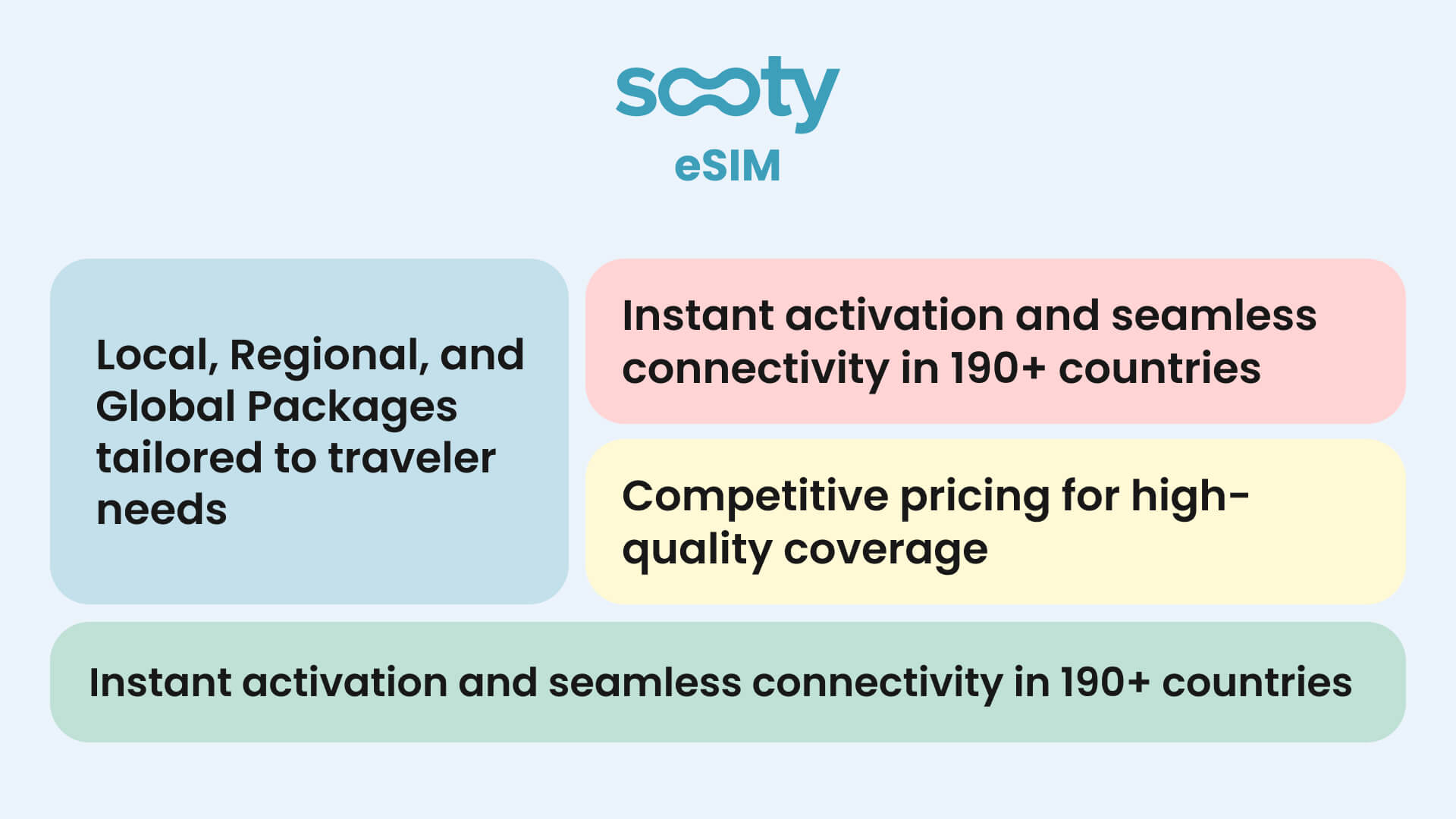
It is therefore mind-boggling to come across Sooty eSIM, an ingenious solution which revolutionizes users’ connection to the internet as they tour around. Some of its distinctive components with regard to viable fundamentals together with its strategic development direction places Sooty in a competitive eSIM app industry frontrunner place.
Global Connectivity
An exciting feature of Sooty eSIM is that they offer the facility to connect across the globe. Users can get connected to the internet in more than 200 countries and no more feeling for local search for SIM cards or paying hefty amounts for roaming. This makes Sooty good for the business people traveling as well as the adrenalin seeking individuals as it allows them to be in touch throughout.
Free Internet for Watching Ads
Sooty sees an opportunity to monetize its product through providing absolutely free internet access in exchange for watching one minute of ads. This approach in addition to making connectivity more affordable also promotes interaction. Due to this autonomy and the ability that Sooty has in offering a service that negates conventional data charges, the service attracts a wide-following including the ‘data shy’ who may be reluctant to purchase data bundles.
Hassle-Free Setup and Multiple eSIM Management
One major advantage of Sooty is that the firm is not like the various eSIM solutions that may require complex procedures to be followed when the user is initiating a connection. There are no lengthy activations, and users can download the app, pick a plan, and start using their eSIM in minutes – no physical swapping needed. Moreover, Sooty enables users to have more than one eSIM on a particular device, so people can easily switch between offers depending on the country without additional actions.
Development Strategy Insights
Initially, Sooty’s development strategy seems to provide a useful case study for planning new eSIM apps from the ground up. Here are a few key takeaways:
- User-Centric Design: That Sooty is keen on making the experience of using it from installation to management of one’s plan proves that the aspect of UI/UX is significant in app design. The need to have an easily navigable app can go a long way in the creation of satisfied and loyal customers.
- Innovative Monetization Models: The integration of an ad-based revenue model that is employed in Sooty shows that different approaches to generating revenue can motivate and attract the right audience. This is good because it means that the app is versatile and can attract thrifty users at the same time bring in revenue.
- Strong Partnerships: Sooty’s success is further enhanced by partnerships with telecom providers; thus, ensuring competitive prices and sound standing data packages are on offer. New applications should get into similar arrangements to improve their operations and scoop up new markets.
Sooty eSIM illustrates how innovation, customer oriented approach and correct partnership can attain good eSIM application. Sooty therefore not only addresses the needs of the customer, but also establishes a template for any application of eSIMs in future that wants to be categorized in the market as easy to use and that provides global connectivity. For developers who want to venture into this promising industry Sooty provides a case study of creating a viable and accessible product.
Explore our Mobile eSIM SDK to seamlessly integrate eSIM functionality into your app.
Conclusion
There are several components that matter for building eSIM apps that contribute quite much to the price as the basic functions needed, the whole process of development, and the set of technologies to be used. Right from user authentication, multiple networks support, integration with telecom carriers, and interfaces they all together contribute to the total cost of the Wi-Fi solution. In addition, the decision as to which development region ought to be chosen can ensure that costs of an organization are reduced without necessarily having to sit through low standard services.
This means that the planning phase is very important for your eSIM application since it provides direction, provides vital information concerning its market and financial requirements. Thus, the proper choice of tech stacks either native or cross-platform will improve the app’s scalability and maintainability, which will consider the end-users’ needs and tendencies in the future.
Discover our White Label eSIM solution to launch your own branded connectivity service.
With this information, anyone planning to start an eSIM app development process should do it right now. Remember, there is nothing wrong with getting professional assistance with the development; it can actually save you time and minimize possible issues while helping to realize your dream designs. Today, this journey towards creating a new kind of eSIM app begins!
Telemedicine App, Social Network App, Healthcare in Mobile, MVP Development, Telemedicine App Development Cost, App Design Cost, App Prototyping, Voice Translation, Mobile App Prototype, MVP Software Development, Development Cost, Free App, NFT marketplace, Blockchain App, SEO, Mobile App, Hybrid Apps, Booking App, Trip Planners, create a voice translation app, Build an App Like Uber, Native Apps, Voice Translation App Development, Uber App Development Cost, App Monetization, eSIM apps
Cost Insights for Your eSIM App Development
Uncover the financial landscape of creating a cutting-edge eSIM app.
Understand the cost factors involved and how to optimize your budget.
We will cover:
✅ Key pricing elements
✅ Budget optimization strategies
✅ Potential ROI insights
Table of contents
FAQ
An eSIM app lets people control their mobile connectivity using an embedded SIM related to a physical SIM card. Carrier billing: It allows the downloading of multiple carriers’ profiles to the device they use so that you can switch between networks and data plans with a lot of ease. Subscribers are able to control their subscriptions, turn on eSIM profiles and use data offers without having their own SIM card.
An eSIM app should be secure for users through authentication and verification; support multiple networks for worldwide connectivity, offer data plans and subscriptions, and operate with mobile carriers and devices. They help to provide integrated and reliable access to mobile services for users regardless of the geographic areas.
The cost of an eSIM app is a relatively complex measure that depends on such factors as complexity, the number of features, the technology used, and the development’s location. You could mark down $50.000 – $200.000 or more on an average based on its characters and objective you have in mind. To be more precise, one should conduct great research and possibly get quotes from the development companies.
The time taken to create an eSIM app may take between 3-6 months inclusive of different phases including research & planning, designing the UI/UX, brainstorming on backend and frontend, testing & deployment. The length of the phase depends on the degree of application complexity and productivity of the team involved. For instance, research and planning could consume between 2-4 weeks whereas UI/UX design entails between 3-5 weeks .
Possible revenue models for an eSIM application are subscriptions for a range of data tariffs, additional options for charge for the app, commissions from telecommunication companies, and advertising, for example, offering free connections in exchange for watching advertisements. Such actions can produce income while making the users of the sites find the services useful.